Showing posts with label Cal 2-29. Show all posts

Tuesday, June 14, 2011

Fettling: the Joys of Kerosene

Patience is a virtue for any sailor, and thirteen has always been a lucky number for me, so it was no surprise that it took thirteen attempts to get my fabulous, vintage Hillerange kerosene stove working efficiently again. It was more than I had bargained for, but fettling is an art that I have come to appreciate if not fully enjoy, and the journey, though long, was interesting and had many a twist and turn! Here is my story:


Dervish, my Cal 2-29, came with a beautiful, vintage, pressurized kerosene range. I had never used a kerosene stove before, but figured I'd give it a try. All last summer I cooked on it, and grew to love it for its  super-hot regulated flame.  The key to a clean flame with kerosene, is to make sure the fuel is fully vaporized. As a liquid it burns yellow, less hot, and is very dirty; it can leave pots, pans and the cabin top sooty. Kerosene is smelly when in liquid form; the fumes can even make some folks sick. As a gas, it has only a hint of an odor, burns blue hot and leaves nary a trace of soot.  I actually like the smell a bit. It takes me back to another time. I suspect I may have been a mariner in a previous life, but that is another story.  Back to the stove...

Gradually over the year, one burner started to seep from the jet, first leaving the burner wet which caused smoking, and later, entirely filling the spirit cup each day. This was stinky and made my guests complain. Quite honestly it was a major pain in the butt to deal with; I had to pressurize and de-pressurize every time I used the stove, and had to sop up puddles daily. The entire cabin began to have an aroma of ode-to-musty-old-sailboat.

Everybody I know tried to talk me out of saving the old range, but I knew I had a good thing and dedicated myself to fixing it. The more I researched kerosene the more sense it made to me. It is clean, cheap, super hot (equal to propane) and has a very high flashpoint (higher than diesel and just below cooking oil) which makes it safe, unlike propane which can go "bahboom" on you. I vowed to bring my old stove back to her full glory.  Little did I know that the adventure I was setting out on would take six months, cost nearly $300 and require the cooperation of people all over the world.

Locating parts for a pressure kerosene burner is very difficult. They don't manufacture them in the USA and there are no major distributors here either. Eventually, I located a company in the UK that sells spare parts, though no complete burners. Mike the Stove Guy at Base Camp was very helpful, and after a long telephone conversation I ordered a bunch of parts to rebuild my leaky burner, and some extra parts just in case.  Sure, it ran me nearly $100 but that seemed cost effective when weighed against buying a new range and installing it. 

The parts arrived and sat in the box for months. Over and over I looked at all the little bits and pieces until I convinced myself that I could never assemble such a thing. The leak got worse, and eventually I stopped using the stove. Plus I was landlocked after my injury and couldn't get to the boat all winter.  When spring rolled around and I moved aboard, I decided I better just jump in and do it. Nobody was going to do it for me. I found a used book by Ferenc Maté, Shipshape: The Art of Sailboat Maintenance, which has a useful exploded diagram of the kerosene burner assembly.


 (This is a great book, and you should click on the Amazon link right now and buy it! Especially, if you have a kero stove or heater.)  Armed with the diagram, I dove into the project and discovered that some of the new parts were not quite right. 
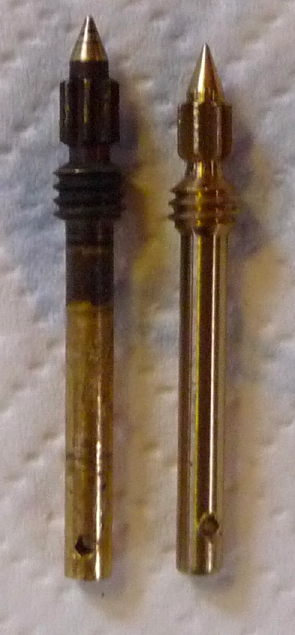
 
The old spindle is on the left and new on the right. Notice that the length is different. This caused the hole (at bottom) to not quite reach the knob that it mates to. It also has slightly different threads that make it incompatible with the old needle. I ended up cleaning and sanding the scores out of the old spindle. I installed a fresh graphite packing nut and after several attempts managed to seat it properly. Voila! She burned without leaking. 

For a day!  Then I noticed a flame under the burner where the gas tube attaches. I had caused a stress fracture from all the gripping during the several tries at seating the spindle and aligning the needle cogs.  You can see the flame in the wrong place in the photo below.


At this point I did what anybody would do: I turned to the web. I found an awesome online forum,  Classic Camp Stoves (or CCS) for kerosene enthusiasts and became the darling of the forum for a couple weeks.  I sought to buy a plug for it, figuring that I simply wouldn't use that burner. I really only need two burners. I convinced myself of this. But it turns out the threading is insanely arcane at 37/64ths diameter and 34 threads per inch at a 55˚ pitch. Nobody had a plug for the thing. Nobody! So, being resourceful, I tried putting some JB Weld on the fracture, which stopped the leak--for awhile. On the third use it got too hot and crumbled off. With few options left, I located a shop in Tacoma where they cut the burner apart and silver soldered the bottom for me. 


I now had a plug that would thread properly. I brought it home and put it in. Finally, I thought, I can cook again! Wrong. The old asbestos washer beneath the plug crumbled. Discouraged, but not defeated I sought professional help from the CCS Forum again. Several forum members coached me on what to do to stop the leak. This phase included driving around to auto repair places trying to get head gasket material custom punched to the proper diameter and thickness. A nice mechanic took pity on me and sent me home with a variety of different copper washers. I tried again and again. But still she leaked! More than ever, in fact!

I must admit, readers, that at this point I actually shed a few tears of frustration. I am not naturally inclined to fix things. I am, and always have been, more of a thinker than tinkerer. I whined a bit about my failures on the forum, and "Kerophile" took pity on me and sent me custom washers in two different thicknesses. These were hand fabricated in the northern most tip of Scotland and came in the mail about a month later!   Kerophile is a dear old Scot who is available to help silly sailors like me with our stove troubles. I didn't know if the washers would solve my problem, but regardless of that, I needed the encouragement and the support he offered. It felt good just to have somebody say my stove was worth saving, and that under no circumstance should I switch to propane. Ah, the connections one can make on the interwebs!

Meanwhile, I was on a mad search for a completely new burner. There had to be one out there somewhere and by God, I was going to find it. I haven't been called a "Research Queen" for nothing, so find one, I did with a tip from another forum member. Southern Lamp and Supply sells Hipolyto burners which are made in Portugal and completely compatible with my original Patria burners (also made in Portugal). I tried to order three (you know, just in case!) but they could only get one for me. Evidently, even the Portuguese had run out!  As far as I know Southern Lamp will be able to get more of these burners in the future, so if you are looking for one, give them a call.

I also got a hold of A and H Camp Stoves in California. It took several calls and emails to get a response; they are a small outfit, but they found one dusty old Patria burner on their back shelf. It was missing a few parts so they hadn't sold it. I bought it from them and waited for the mailman. I also spent an afternoon talking with various Amish men. Each thought another guy might have a burner somewhere. The Amish use kerosene almost exclusively and although very friendly, they are sometimes difficult to reach given that most do not use telephones. I had some delightful chats with various chaps, but nonetheless, the Amish whirlwind did not yield any regulated burners. 

A couple of weeks later my first new burner arrived from Portugal via North Carolina. I didn't waste time, but immediately tried to install it along with a new washer/gasket. All went well, except that once I had it tightened down, it was not aligned with the control knob. Now, I know better than to over-tighten things, but it only needed about 1/8th of a turn. I held on with pliers and wrenched that baby hard!  Something gave.  Oh, shit! I bent the feed tube (if only I had used vice grips for a better hold!) and fractured it.  I had the new burner, but the feed tube was now cracked and gushing kerosene. (It was later pointed out to me that I had forgotten to put the spirit cup on, evident in the photo below. Doh!)


Once again, I cried. I know most people get mad and swear at these moments, but I cry. Guess that is just my way. 

But would I give up? Hell, no!  When I set my mind to something, I do it. One way or another. So, I cleaned up the stinky mess and posted on the CSS forum again.  This time, Dale, a sweet and helpful sailor up in Chimicum, offered to solder my feed tube for me if I brought the stove to him. I did. Shawn helped me wrestle it out of the boat and off we went up the Olympic Peninsula. It was a beautiful day and I felt enthusiastic. Finally, my stove would be working, and I could move beyond the raw food diet I had been forced to live on. I think it was around this time, I dubbed the stove, "Faith."

Dale was wonderful and spent four hours teaching me everything about kerosene burners and the finer details of maintenance. In the end, he soldered the tube up and after testing it with soapy water and an air compressor, sent us on our way. 


When we got  back to the boat, Shawn lifted Faith aboard for me and we fired her up. Guess what? Kerosene penetrates like nothing you have ever seen. So, yes, you guessed it. It leaked through the solder. Okay, this time I didn't cry, but rather uttered some choice expletives. But give up? Hell, no!  

Three more days of calling radiator shops and refrigeration repair places. Nobody would touch it.  Finally, I removed the copper tubing assembly and drove to the biggest machining, fabrication and welding outfit I could find, Mega Machine. I walked in there and told the receptionist that I was not leaving until I either had the thing repaired or the name of somebody who could do it. She called up Larry from the shop, who told me they didn't do that type of work there. I said I knew this, but surely there was an employee or somebody that someone knew who could do this work for me. I repeated my intention of staying right there in that office until I had a lead. I would not take "no" for an answer. Larry, scratched his head for a moment, then told me to look up Bert at Inlet Connections. I threatened to return if Bert couldn't do the job; I was not going to let Larry off the hook. He appeared annoyed, but secretly I think he was a little turned on by firm resolve.  

I headed downtown to Inlet Connection to talk to Bert. I found him in his shop and explained my  dilemma. He told me he had silver soldered custom artsy sprinkler heads with dragonfly wings and layered flower petals. He made custom fixtures for the State Capitol building. I knew right away, Bert was my guy. Soldering stoves was not something they do at the radiator repair shop, but he was willing to do it "on the side" for me when he could find the time. I left the burner assembly in his care and hoped he wouldn't take too long. The very next day he called me. It was done. All he needed was for me to pick up a fifth of Crown Royal Reserve. I did. And for that bottle of whiskey I got my fuel tube repaired. Now that is the way the deals should work!


Back on Dervish, Shawn and I installed the thing and managed to get the burner on, aligned and tightened just right with a combination of new washers from Scotland and the thin asbestos ones that came from Portugal. The trick is to use enough washer material to get the burner to tighten down AND line up with the knob assembly. To do this you have to experiment a bit with different combinations of washers. I fired it up , and oh baby baby, she burned. No leaks.  But the next morning as I tried to boil water for coffee, something was still wrong. The flame puffed and fluttered and then went out with a huge plume of black smoke. What!?  

Turns out I was out of kerosene, so the final chapter of this story involves researching the best fuel to burn in good old, Faith.  In hardware stores you will pay up to $12/gallon for K1 grade kerosene. But did you know that jets use kerosene as fuel? They do. Airports have huge tanks of what they call Jet-A fuel which they sell for around $5/gallon. This is basically the same as K1 but a bit more refined. If you ask them for the sump fuel (the stuff they drain off regularly to check for contaminants) they will give you an even better discount. I got a gallon for $3 and was told I could get all I want at that price. And let me tell you, the stuff burns hot, clean, bright, and almost without any odor. I love love love it. I still haven't used the oven, but the burner in it works. I need to buy a thermometer and figure out a way to keep the temperature more or less stable. I'll be sure to post my experiences with baking in Faith as I gain them.

So, there you have it!  My fabulous fettling ordeal and the grand success at the end of the story. In truth, my stove is still not 100%; I now have another burner that is a little seepy (probably from all the tweaking and stress of disassembling and reassembling).  But I can fix it. I know I can!  I have the parts, I have the knowledge, and I am developing the patience. Fettling isn't for the weak willed, but then, neither is sailing.  

Feel free to contact me if you need encouragement with your old kerosene stove. I just might be able to help.


Friday, March 11, 2011

Engine Alignment and Spinal Recovery

This week my dream, six years in the making, quietly emerged; I now call s/v Dervish my home. In truth, I will be spending most of March and April away as I work a temporary job to feed the cruising kitty. For now, this week, I am aboard and surrounded with all the stuff I couldn't bear to part with. I have been paring my life down with each move (6 moves in 8 years) and still I find incredible redundancy. I own so many objects in duplicate or even triplicate. I never realized this before. Look around, I bet you do too--unless you live on  a boat, in a bus or on a bike.

The actual move was brutal due to a late February blizzard that left the docks iced over and treacherous. This, combined with steep low-tide ramps, made transporting my carloads of small boxes (small because I can't carry more than 25 lbs) nearly impossible. But tell me, what is the use of realizing a dream if you don't have some adversity to overcome? Just like a good movie plot, I had many obstacles between me and my aim. 


My spine is still healing; I am now in the fifth month since the big crash. I am pretty much out of alignment from occiput to sacrum, however, each week is a little better than the last.  I can feel my core muscle strength developing. Carefully shoveling snow with a small dustpan served as a meditation in conscious movement. I worked for over two hours clearing the deck and chipping the ice from the cockpit so the scuppers would be clear when it finally started to thaw. In addition to my boat work reconditioning regime, I continue physical therapy and weekly massages. I am determined to return to my pre-accident condition or better. I fully intend to sail my little ship north this summer.

Meantime, I plod along with the boat projects. Dervish was in desperate need of her own alignment; the 12hp Farymann A30 single cylinder diesel engine was as out of whack as my back.  I always thought the motor seemed to jump around a lot and was terribly noisy, but since I had zero experience with one cylinder engines, I accepted it as normal. Wrong.


It was nearly a quarter inch off (no kidding), which was likely the cause of my dripping "dripless" shaft seal. That seal has been leaking since the day I launched Dervish. First time out I noticed water spraying from it and running into the bilge. It wasn't much, not enough to trigger the bilge pump's float switch, but enough to coat everything with sea water. I soon tracked down the shop that installed it in Coos Bay, Oregon and eventually got the technician on the phone who did the work. He remembered the boat and assured me it would improve with time, which it did. Evidently the interfaces need a little run time to mate up properly. It did improve after a few hours of use, but all last year, the seal continued to spray a little when motoring.

Shawn and I took a look the motor mounts, and he pointed out that they weren't easily adjustable with a simple turn of a nut like some are. I noticed the port side had a shim between the mount and the stringer that the starboard side did not have. My engine was actually laying on the starboard stringer as a result of the sheared bolt, and missing second mounting bolt. Correcting this would bring everything much closer to proper alignment. Shawn was able to jack up the motor and add the missing shim to the starboard side, replace the bolts, and align the engine coupler with the shaft coupler. Below is the starboard mount after the fix.


Like me, it isn't in perfect alignment, but it's much closer to the specified gap allowance. I haven't had a chance to take her out for a test yet to see if it solved the spraying shaft seal issue, but I do know that there is a significant reduction in vibration and noise. And I can rest assured that my little one-lunger isn't going to rattle completely loose!

While we were in there, we took the raw water and exhaust hoses off. I was amazed to see how much crud had encrusted the engine water intake. Unbelievable! The diameter of the pipe was probably reduced by about 25% due to the build-up. Shawn scraped it out with a screwdriver. Eww...


The water hose had chafed pretty badly in a couple places, so it was prudent to replace it. We looked everywhere for a decent one and ended up buying some West Marine hose which, although it had the same inner diameter, was much thinner walled than the original. Seems most things are poorer quality anymore. Shawn zip tied a little extra chafe protection on just to be on the safe side. (I like the safe side!) The picture is at a poor angle which makes the bend look much sharper than it really is. The new exhaust hose is also visible in the lower right.


As I type this from aboard Dervish, my neck grinds a little with each turn and my back has "adjusted" more than once already today. I may not yet be completely straightened out, but at least my motor aligns and my hoses are new! It will officially be spring in less than two weeks, (lovers awake!) the daystar burns through now and then, and I continue to meet interesting new friends who want to sail. The adventure is beginning, and this time around there is nobody but myself to hold me back. Watch out! 


Saturday, February 19, 2011

Charging Forward Old School!

My Cal 2-29, Dervish, has been getting some major work this month. I've got several projects going on and could almost do a post everyday, if I weren't so darn busy tending to my life. I'm out of my apartment in a week, trying to line up some temporary work to fill the proverbial "cruising kitty," and even managing to find time for dating. I won't be going into that today though. Instead, I'll limit this post to recent work on my charging systems.

Dervish inherited quite a lot of hand-me-down gear from Nomadness and the Microship, for which I am very thankful. One of the more useful things was a TrueCharge Statpower battery charger. (It is now the Xantrex TrueCharge.) At a measly 10 amps, it is a bit on the small side, but since Dervish doesn't have refrigeration, or power hungry instruments, she uses very little power now, and will use even less once I swap out the failing, fluorescent cabin lights for a couple of low power LED dome lights.

The TrueCharge unit, though originally thought of as a temporary kluge, has been working sufficiently for a year. Why not stick with it?  It is a three phase smart charger with dual leads for my two batteries. It is now mounted at the back of the starboard quarter berth where the old scorched Dytek charger once lived and died. In some ways this isn't the best location because I intend to use that berth for storage, which will make it tough to see the charge status lights, but again, convenience dictated. Better to get it done than put it off again waiting for the perfect solution. Moving it later is always an option.  At least it's not simply clipped on as it had been for the past eleven months. I've already had one fire as a result of that! (Click here to read that adventure.) The switch next to it may not be necessary, but it was already wired in to the shore power. I figure if something were to go "haywire," I could manually shut off the charger. Then again, I could probably disconnect shore power more quickly. 


Next we tackled the bigger issue: the engine charging system.  Last summer one of my two batteries had bloated up a bit. We suspected it had over charged, so Steve disconnected the alternator before I put in two new group 27 deep cycle batteries.  I didn't want to risk damaging them with over 16v or more surging in. 

The alternator remained disconnected for all of my outings last summer. It wasn't too much of a problem really, as I was rarely on the hook, and miserly with power the few times I did anchor out. Still, I knew it was something that seriously needed attention. For Dervish, I try to only buy new gear if the old stuff can't be fixed, or if it becomes (or could become) a safety hazard. I like to stay old school when possible. In that spirit, we carried the alternator and voltage regulator to the local guru at Dan's Alternator and Starter Service. 

Now, Dan is one of these guys that does what he knows how to do, and does it very well. One thing Dan knows, is alternators. He knew my Motorola 37 amp 12v marine alternator intimately. He is also a nice guy and honest; he isn't going to try to sell you something you don't need. Especially not if he can fix it. Dan clearly takes pride in keeping old parts functioning, which, in this day and age, is a rarity. Evidently few shops still rebuild components like these. Why should they? Can't you buy a new one for nearly the same price and get a warranty? Sure, you can always buy a new something, but rebuilding or refurbishing an old part to give it new life, is more satisfying. If guys like Dan can stay afloat in their business for a few more years, I think they will recover. If our economy continues downward, people will be forced to repair what they have. When goods become too expensive in a market where the dollar is no longer almighty, guys like Dan will be highly valued.  But I digress...
Dan said he would test the alternator and open it up to see if a rebuild was in order or if it was irreparable. If I needed a new one, I thought I'd get something beefier than 37 amps, something newfangled with an internal voltage regulator.
In the shot above Dan is opening up a Delco alternator, not mine, (unfortunately, I didn't get down there with my camera in time) or even the same make, but he reminded me as he opened it that "basically, all these things work the same way."  


Most alternators look something like this inside. Again, I was delighted to discover that it isn't really all that complicated. It is empowering to demystify some of this stuff. Strange that it took me so many years to discover that I actually enjoy learning how things work. 
Alternators have stator coils fixed to the housing and rotor coils that are driven by the motor. The rotor produces a field current as the coils rotate. The strength of the field current determines the strength of the magnetic field. The magnetic field has, like all magnets, a north and a south pole.  The rotor, driven by a pulley when the engine is running,  supplies current to the coils via a set of brushes.  As the rotor coils couple with the stator coils it produces A/C, which is passed through a few diodes that rectify it into D/C which can then nourish your batteries.  

When Dan took my alternator apart, he found the brushes and coils were absolutely fine. The bearings, however, were toast. Below is a bearing exactly like the one from my Motorola. This one is pretty gunked up, but evidently mine was worse. 
Fortunately, I hadn't run it until it had frozen up and completely destroyed the whole unit, so Dan was able to replace the bearings without having to do a total rebuild on it. He assured me it was a good little unit worthy of reuse.

When we returned a few days later to pick it up along with the new voltage regulator, Shawn and Dan marked the wires and terminals to insure proper installation of the new regulator. You really do not want to hook it up incorrectly, and it isn't all that obvious by looking at it, which wire goes where. Here it is all clean and reinstalled. The new voltage regulator is fastened to the inside of the engine compartment just a few inches to the right. It has been tested and works great! Plus I get "reuse" points, and I saved around $60!
Times are tough and the economy is poor; little shops like Dan's are becoming scarce. I encourage anybody in the South Sound area to take your business to Dan the alternator man. He'll fix you up. Old school. His shop is a metal mess of parts both new and used, but Dan knows exactly where everything is. You can easily miss his sign on Black Lake Blvd, and I told him as much. He said he was thinking of investing in a new one. He knows an aspiring, young artist whom he'd like to hire for her first paid job. If you visit him, be sure to tell him Sky sent you!  
3614 A Black Lake Blvd. S.W., Tumwater, WA
(360) 352-4523


Sunday, February 13, 2011

Pedestal Project

As the long awaited and highly anticipated move aboard date approaches, I find myself excited and yet, a little panicked. Over the past week, I have had some recurring thoughts: Where will all my stuff go? I have no hanging locker. I have no refrigeration. My fuel tank is empty (and probably growing all sorts of biology). My charging systems are either jury rigged or completely disconnected. My vintage kerosene stove has a leak (I bought the rebuild parts from England eight months ago, but have I not fixed it yet). My wheel is so stiff that the rudder hardly moves, and like every boat I've known intimately, my plumbing could use "some work." I wouldn't even let myself think about wiring. My how quickly a perfectly sailable boat can become The Project Made of Many Projects.

But if you know me at all, you know that I am not easily daunted, and although I am still healing my injuries, I am ready for whatever the universe throws in my way. Nothing like a few hard knocks to wake me up and send me crashing straight through a stagnant phase. (I think Gurdjieff called these shocks.) I hold the same thought/feeling each night as I drift between the lucidity and dreamland. I envision good things working their way to me. Right now.

As it turns out some of these were much closer than I ever could have imagined! A friend I met awhile back had offered to help me with some boat projects. Shawn is a competent mechanic who understands the workings of marine systems, so I brought him aboard Dervish, to give her a looking over. He decided the steering pedestal would be a good project to start with because "you don't want that thing failing on you."

The first step was to open it up, so I could see how it worked. It really isn't such a complex thing. Here you can see the two cables, one for shifting and one for throttle. The big chain that couples with a brass sprocket (much like a bicycle) controls the movement of the rudder through cables and sheaves.


You can see that it was quite grimy. Shawn cleaned and lubed it up, but it remained stiff. We discussed the parts that could be the culprit and came to the conclusion that the bearings may be bad; I ordered a pedestal rebuild kit with needle bearings from Edson and waited.


When we returned two weeks later, the wheel was moving nicely due to the lubrication having worked its way in. I didn't need the kit after all! Shawn dismantled the rest of the pedestal parts and sent me home with some sanding and clean-up to do.

Unfortunately he also found what we thought was a broken bolt, but what turned out to be a broken off drill bit. Ultimately, the pedestal would get reassembled with only three of the four fasteners. Though he did install a stud to help hold the bottom half in place. I don't know how long it had been that way, but I am sure she'll hold up just fine.


Once the parts were sanded and cleaned up, Shawn put a few coats of Helmsman Spar Urethane and some fresh paint on, and we met at the boat for reassembly. Here he is drizzling a bit of motor oil onto the chain to lubricate it.


After dry fitting the pieces together, a bead of 4200 polyurethane was used to seal it.


Here is the final product. I just love how tidy and pretty the whole thing looks. Much better than it was, and most certainly better than I could have done. I am inspired to sew up a cover for it now.


I am honored to have so much generosity and expertise come my way. This week I plan to take her for a spin, fill her up with diesel and begin to prepare my little escape pod for full time living.

Next up? The charging systems. The stove. And art and adventures.


Thursday, March 25, 2010

The Project List Is Devouring My Calendar!


As a new boat owner, I am finding myself simultaneously smitten and overwhelmed. Steve is the Listking and has conveniently helped me to sort out all the things that must be done to Dervish before cruising season starts. He has posted a new list of my tasks along with his (much longer) list on the Live Page of his website. As things get finished we line them out and leave it for a few days so we can feel accomplished and show off to our friends how productive we are.

Before getting into the details of boat projects, I will assure you that I did get out sailing on an overnight trip to the homeland aka Camano Island. Steve crewed on the sail over which was predictably sweet, gentle and perfect. We grabbed a friend's buoy and had a glass of wine and some snacks aboard with Camano friends before going home for the night. The next day he drove back to Oak Harbor (where we moor) while my friend, Bonnie and I sailed Dervish. When we left Utsalady Bay it was warm and sunny with only a whisper of wind, but determined to sail back, I insisted we shut off the diesel. We drifted a bit trying to figure out how to capture the elusive and very squirrelly little puffs that came intermittently from the west, south or north. Then, as we rounded Rocky Point we found some wind. And boy did we! In less than five minutes it went from 3-4 knots to about 15! Yahoo! Dervish kicked up her heels and we were off! Before long we were facing whitecaps, a 20-25 knot southerly and 4 foot seas. A lot of fetch had built up in the mighty Saratoga Passage! When we hit 6.6 knots with the rail in the water, we discussed reefing, but decided to just hang on and sail a beam reach west across the passage. Once in the wind shadow we turned north for a downwind run to Oak Harbor. I can't even express how good this felt! I gained so much confidence both in myself as skipper and in my little boat. Even in those conditions, we were dry in the cockpit, and she held course without too much effort. Steve snapped this as we came into the marina after the epic crossing.


Once that trip was over it was time to get busy on the To Do list. One of the more frustrating projects is the repairing of my leaky Hillerange kerosene stove/oven. I really wish to keep this stove as it burns wonderfully hot, simmers well, doesn't have a risk of exploding and burning my boat to the waterline, and best of all, is already on the boat.


I considered replacing it with propane, but the cost of a new range, installation of an outside locker for fuel storage, venting (and all that goes with it), is more than I want to spend right now. Yet being able to cook is hugely important to me. I want to be able to make everything I love and bake goodies aboard. A one burner camping style cooking setup simply is not good enough for me. So, I have decided to roll up my sleeves and figure out how to repair the leaks. The problem is that the only place on earth I can find that sells replacement parts is in England, Base Camp Stoves. They have an old phone system and the message I get (at 8 am or past midnight-- time difference has its own challenges) states that their mailbox is full. I have tried three times now and no luck. I could order via email but need to talk to an expert to make sure I am ordering the right parts, especially since it will probably be a month before I get them anyway. Sigh. It could be awhile before that one gets crossed off. Meantime, I have to sop up leaked kerosene before starting the stove every time. This stinks!

Another issue I have run into that I thought would be easy, is putting the new name on. Turns out the old name is painted on and the hull is also painted. I can't sand off the lettering without sanding the entire transom and repainting. I have been collecting ideas on how to approach this, and purchased some nontoxic paint stripper to try. I do, however, have the new lettering and once the transom is bare, it will be trivial to put on the pretty new name in lovely copper-colored letters.

But I have managed to get a few projects completed. I have replaced the old Hawaiian floral curtains with some darker, heavier, ones.

Sewing curtains on Steve's mom's White in the cold, cold lab.

Insurance has been purchased and the Washington license numbers are now on. I am legal. I also acquired (thanks to a barter deal Steve did) an alcohol cabin heater, put nonskid patches on, put in a new fresh water pump (well, Steve did it really, but I could have) and purchased safety netting to keep Zubenelgenubi and crew aboard. I bought it from On Deck Sports because they had the best deal. It was just over half of what I would have paid for marine safety netting. It came with a convenient sewn rope border, UV protection and cut to size. I'll be installing it very soon and will try to put a picture up when it is done.

Speaking of pictures, the reason I don't have many photos this time, is because my camera died. If you (or anybody you know) has a digital camera with a decent zoom you'd like to sell, by all means contact me.

I am planning another trip to Olympia soon. My father has been having some health issues, and I'd like to be close for awhile. This will be a three day trip with two overnight stops. I need to refine my anchoring system a bit before leaving, but hope to get out in the next weather window. Until then I'll be taking on that To Do List with gusto!


Friday, February 12, 2010

My Escape Pod

The night is black and wet and blue green on Saratoga Passage. Cool, still and damp. I pull from the half empty Sailor Jerry's Spiced Rum bottle and spread the sail cover across the deck. I am thankful that I made the trip without too many problems. Zuby watches curiously as I raise the bottle and nod toward the heavens. I didn't get the name off the hull. I didn't do the de-naming ceremony. I know I am pushing my superstitious luck, so I toss a splash of rum on the anchor and decide not to push it any further. We're hanging off an unknown mooring, and though the predictions say it will be calm, one never knows; methinks I've had enough grog for one night.

Zuby shadows me as I ramble back to the cockpit. I pause in the companionway struck by the contrast of colors and sensations. Outside it is huge and dark and very, very quiet. Below it is small and glows warm and woody. The red cushions that I couldn't decide if I liked are now inviting and womb-like. The oil lamp flickers and the kerosene stove hisses. My copper tea kettle steams. I could be anywhere. It could be any time. I go below and pour a thermos of Korean corn tea then fill my fleece-covered water bottle. What a simple comfort! A must for a chilly boat.

Back on the deck I listen to dogs barking in the distance as I gaze at the stars. I know so very little about the stars. I resolve to learn more and perhaps someday know how to navigate by them. I check the line tied off to the buoy before lying back to contemplate the vast emptiness. I sip my tea. The rum kicks in. I laugh at myself. What good fortune I have created. This definitely does not suck. In fact, it is better than I ever anticipated. Aesthetically it is intoxicating, and the sense of freedom humbles me.

As I sip my tea and snuggle with my pup, I wonder at it all. Images from the past three days--the first three days aboard
Dervish - dance across my mind's eye. My Canon S2 camera died recently leaving me to rely mostly on memory. The few photos I have from the 120 mile delivery from Olympia to Oak Harbor trip were taken on Steve's camera. He traveled the whole way to Camano with me and served as Chief Engineer, Human Whiskerpole, Bartender, Helmsman and Lover. I couldn't have made the trip without him, nor would I have wanted to. But now, he is back at the homestead, and I am here aboard my very own boat, alone and very much alive. I am pregnant with the possibilities, the dangers, and the incredibly exciting and unpredictable future that I am stepping into.

Only three days ago I left Olympia. I was excited but nervous and somewhat tentative at the helm. That first day I made the short trip north to Boston Harbor with my partner, Steve Roberts and Cathy Starck Nemeth aboard as crew. It was a gorgeous south sound evening.


We arrived at Boston Harbor just before six pm. I really love the hometown culture and the wonderful characters who people that little marina. They even have a resident seal who escorts visitors down the docks. There are also eight or so local dogs that visit and roam the marina store at different times. They remind me of my little Corgi Lily who was well known at this marina. When Zuby was bitten by a local Golden, I had three different people offering their phone numbers and accepting responsibility for any damage. Luckily, Zuben was bruised but otherwise unharmed, but that is just the way people are around there. Wonderful and decent.

The dog fight did add to the general chaos of our arrival though. We had many logistical problems to work out including car transport, lost keys and mis-communications with our dinner hosts. After a lot of finagling - including being coached by a ten year old girl on the finer points of using a coat hanger to jimmy in through the window of my car - I managed to find my keys and deliver my very patient friend back to her boat at West Bay.

The rest of night, however, was delightful. We had a huge meal of fresh steelhead from the BH Marina store
with our good friend Suzanne and her date, Al. Then we retreated to Dervish for a good night's sleep before the real journey began.

Next day we got off at about 10:30 with the goal of hitting the Tacoma Narrows at peak current and stopping at Gig Harbor for the night, both of which we eventually did, but not before we had just a wee bit of excitement. Motoring through Balch Passage we smelled some smoke in the cabin (oh god!) but it turned out to be exhaust. When Steve, acting as Chief Engineer, went to investigate he discovered water gushing into the engine compartment. A hose clamp had failed on the line feeding the engine raw water. He hollered up for me to cut the motor so he could replace it. I could still see water sputtering out the exhaust and looked around at our position just off the McNeil Island penitentiary docks. I put the motor in neutral. We started drifting toward the prison. I had to motor away. They might send out gun boats or something crazy. Steve did the miraculous and wrestled a new clamp on while we were underway. His hands shook like crazy, he burned his fingers, and he got a bit wet, but he did it. We were soon back on track.


We hit ten knots under the Narrows bridge and made Gig Harbor well before sunset. I called ahead and secured a slip at Arabella's Landing for the night. What a sweet little private marina! You can't beat the unlimited showering and friendly staff. After a walk through town for provisions, I made dinner aboard as Steve rigged a sweet little blue tarp boom tent (a dodger is high on the list of immediate projects!) and we settled in for the night.

And most importantly, we indulged in something I have longed to try for decades: Absinthe, the famed drink of artists and writers of Paris around the turn of the century. A drink shrouded in mystery and brimming with history. It was legalized in the US only a couple of years ago. This was my first experience with the strong sweet, anise-flavored, wormwood spirits. Let me simply confirm that "chasing the green fairy" as it is sometimes called, led to some luscious conversations and inventive lovemaking. I highly recommend it! Here I am pouring ice water over a sugar cube into a shot of the green elixir.


Next day we woke early without a trace of a hangover and went into town for breakfast before motoring up Colvos Passage. As we passed Blake Island, the wind blew light and southerly so we put up the sails and headed across the channel. Once we cleared the shipping lanes we turned dead downwind and ran wing and wing all the way to Shilshole Marina. Steve became the wondrous human whisker pole by holding the genny out with a boat hook. Honestly, it isn't as easy as he makes it look.


It felt like we were hardly moving but one look at the little dinghy, Hamster and it was clear from the wake that we were making good time. In fact, Dervish averaged about 3.5 knots and held her course quite well.


Zuby was getting used to boat travel by now and thoroughly enjoyed himself even when the wind was enough to make him squint as we raced along.


Shilshole was surprisingly quiet. We butt sniffed about (for the uninitiated, that means walking the docks checking out boats and peering around at their sterns for names) met some nice folks, and continued with the absinthe rituals. Uh-huh!

Next day we motored up past Gedney Island and along south Camano in what is known to the locals as The Mighty Saratoga Passage. The wind kicked up from the north as it often does there, and we did some close-hauled sailing for awhile. I was amazed to find that we could set Dervish on her course, straighten the rudder and just let her go. She didn't round up at all and actually gained a couple tenths of a knot without human interference. I am not sure what that says about me as a helmsman, but surely it proves I've got a sweet little sailing vessel.

When we finally gave up on beating our way into the wind, we powered up and chugged along to Indian Beach off a friend's house on the west side of Camano. We made three attempts to set anchor, but it just wouldn't grab. I think there is a lot of eel grass there, or perhaps I am simply incompetent. Either way, it was getting dark, I was exhausted, and Steve was eager to get home - now only half a mile inland. I didn't feel confident about heading on to Oak Harbor alone in the dark, so we grabbed a buoy and hoped for the best. We hauled ourselves into Hamster, rowed to shore and continued home with loads of stuff. I returned to Dervish a few hours later to spend the night alone. It turned out to be a magical night and a very important experience for me. The depth of feeling that came with the realization that I finally have my own boat, that I am the skipper, and that I am free to move about the planet made my heart swell and my imagination leap. I am about to embark on a journey both of spirit and in the flesh that will surely change me. It already has.

I made it through the night and single handed it over to Oak Harbor the next day without incident. Dervish is home now, and so am I. Once we get the homestead rented, the next phase of our journey will begin. Our flotilla is forming and the Dramanauts and Traveling Circuits are about to be born. My escape pod awaits me, bobbing happily at the dock.