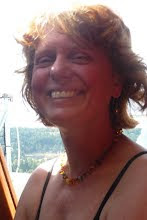
My grandfather, Lloyd Joseph LeRoue was born April 17, 1914 in White Swan, Washington. He was the youngest of twelve children. Lloyd was a handsome charmer from the beginning and remained one to the end. In fact, all the LeRoues were colorful and well known in the Yakima Valley. Lloyd married Audrey Braniff, and had three daughters, Darlene aka Doc, my mother Audrey aka Weedy, and Dolly.
In the 1942 Lloyd became a Jehovah's Witness, and remained devout, never wavering, his entire life. His faith led him to be a man of peace, declaring his truth and denouncing the evils of war. There is a picture of my mother, no more than six years old, with her sisters, on the streets of Seattle carrying placards for peace, and handing out Watchtower Magazines. Here they are in a family portrait from a few years later.
Though he worked at times at a sugar beet factory, as a farmer, and ran a hotel for years, LLoyd was enterprising in some unconventional ways. He panned for gold (though I doubt he found much) and was an inventor with a few patents. One was for a hollow telescoping fishing pole with the line running through the center. The pole was an inspiration designed to keep his grand-kids from tangling their darn lines up all the time. He took us girls fishing fairly often, and I dare say he spent more time untangling lines than landing fish. Lloyd always had plenty of ideas and tinkered with many inventions. He also enjoyed hunting for stones and polishing them in a tumbler. And he loved gardening and growing his own food. He had a green thumb and weakness for raw garlic. I remember the twinkle in his eye and that gorgeous smile of his when, a few years ago, he responded to my question as to what kept him so healthy all those years. He claimed it was a combination of raw garlic and his love of god. "Really, my girl, that's all there is to it," he said winking.
He loved spreading the "good news" and traveled to many Jehovah's Witness conventions. He always did a lot of driving and came to be known as "Whiplash LeRoue" among his brothers in the Witness Work, because he was a notoriously bad driver. He'd slam those breaks at the sight of somebody in their yard, then throw it reverse. Traffic be damned if there was a soul to be saved!
I remember riding with him in his big dirty dump truck... me in the middle and my two little cousins, Penny and Thea, on either side. All three of us squeezed into one seat-belt, flying forward at every stop and giggling our heads off. All the grand-kids adored GrampaRoo. He made crépes every single morning and was always in the mood to get something done. And since he never worked for anybody but himself, he could always use the help and company of his grand-kids. He was fun to be with and a great teacher.
Lloyd was not a highly educated man, but that never stopped him from taking on any project. He taught himself anything he wanted to do, by simply doing it himself. After his kids were grown, he built a beautiful house on a hill above the Yakima Valley where he lived until my grandmother, Audrey, passed away. I think the pain of living without Grandma in the home they dreamed about together, was just too much for him. Later he married Olive LeRoue and became a devoted father to her children and grandchildren. And he was a great resource and respected member of his community. Lloyd was always willing help a brother or sister with any project, sharing his knowledge and experience.
Lloyd LeRoue passed away on August on 13, 2009 at the age of 95. He outlived two of his daughters and all of his siblings. He was strong until the very end. Lloyd's loving wife, Olive cared for him at their home in Yakima until the last week or two when he was admitted into a nursing home.
To be honest, I think we all had our difficulties with Whiplash LeRoue at one time or another; he was hard-headed and willing to argue endlessly for our soul's salvation. It seemed a nuisance to always have to hear him preach to us. But ultimately, and deep down, I think we all respected and admired him. I know I did. A man of his convictions who actually lives by them, a man who walks his talk, is a rare man indeed.
There are plenty of stories about Lloyd "Whiplash" LeRoue and if anybody wants to add one, please do in the comments.
Showing posts with label history. Show all posts
Thursday, August 27, 2009
Tuesday, January 6, 2009
Our Legacy
Tears2 by gregizzlegabrizzleWith the recent passing of my canine pal and a life-threatening infection in my aging father's hip, I have a had a lot of emotional activity to observe in myself lately. To put it simply, I've been about as much of a wreck as I can be. To any outsider, I am equanimously handling each challenge with a modicum of grace, but internally... oh boy! I observe myself struggling to keep a rational perspective while tsunamis of emotion crash on my inner shores. It is fascinating to watch how quickly my thinker starts churning up fearful thoughts and negativity.
This may qualify as "navel gazing" to some, but now and then, when things get very intense, it enables me to step further back and look at myself and humanity from some distant stance beyond my own life. One of the observations that keeps popping up, is how very wrongly we live in respect to animals. I see how acutely I suffered the loss of my doggy, and I know that many many people feel as deeply toward their own pets. Yet, in spite of this indisputable bond we make with our pets, many of us go on munching bacon, fishing out the oceans, harassing marine mammals, enslaving elephants, chasing down wolves from helicopters, and so on. I personally do not participate in all of these activities, but we humans do. We are all part of the human family that has become shamefully dysfunctional in relation to coexisting with other species. In the same way we feel deeply for our own family or friends and protect them fiercely, we feel for our pets, yet dismiss and disregard the well being of other animals and peoples.
I am no history expert, but I think most historians would agree that the domestication of animals was a major leap in human social evolution. It started with partnerships. Wolves and humans competed for the same prey and teaming up was mutually beneficial. Later nomads started keeping herds of sheep and goats, which insured against starvation of the clan. Eventually plants and food source animals became domesticated by humans and were an important part of the fundamental shift to settled communities and the rise of civilizations. With this change in basic human behavior came change of diet, the introduction of infectious diseases, and a wide range of other biological shifts in human evolution. In short, when our relation to other species changed, we changed. I am, of course, drastically simplifying a very complex topic, but the point being, that the human relationships to animals has been a major factor in our development both socially and biologically. A decent article on domestication of animals and plants is posted here, and there are dozens of books on the subject.
Domestication of wolves began 13,000 years ago, but, where are we today? The way we raise much of our food is a shameful abomination. In truth it is so horrific that few can bear to honestly acknowledge where their food actually comes from. How did we go from partnerships with animals to the enslavement and torture of so many creatures?
I have a suspicion that there is another huge step in human/animal interaction that is already underway. Many of the beliefs we have held about animals are now being examined more closely and some even proven false. Assumptions that animals do not have memory, cannot plan, do not feel emotions, have inferior systems of communication, do not use/make tools, or sophisticated social contracts are all being scrutinized by scientists. The results are astounding, and to me, the seeds of a revolution. Birds can learn our language and actually communicate their desires to us. Crows make tools and use them to harvest food. Whales develop complex languages and communicate across oceans to set up meetings and share information. Elephants recognize and respond to skulls and ivory from their own species and are reported to show signs of extended grieving for lost family members. Moved by music, camels weep. Dogs smell disease in humans. Primates exercise self control and plan ahead. I could go on and on...
Of course folks will say that these achievements are a drop in the bucket compared to human achievement, but we must remember that we are also measuring these critters by human standards. If we were to measure humans by animal standards we would quickly see that we are inferior in many, many ways not the least of which is sensory perception.
I sometimes try to imagine how aliens would see humanity as a whole. Gurdjieff did this brilliantly in "Beelzebub's Tales to His Grandson" and points out the absurdity of what he terms "process of reciprocal destruction." But what about the destruction of other species? I believe the effort to understand the intelligence of other species is a frontier that will yield nothing short of a huge evolutionary leap. So many of our technologies are weak efforts to do what animals do naturally and expertly: navigation, long distance communication, disease detection, architecture, flight, sonar, and the list goes on... if we have figured out how to do something with technology there is likely a counterpart in nature that has the ability built in.
What would our world be like if we truly cooperated with other species, letting each do what it has evolved to do? I for one, believe it would be far superior world. What arrogance has implanted itself in our hugely complex thinking apparatus that convinces us that we are superior to other creatures? Or more fundamentally, that we are separate? It is my wish to live to see the day we treat humans as humans and elevate animals to their rightful place of respect in our world.
Labels:
communication,
Critters,
death,
history,
philosophy
Wednesday, November 26, 2008
Victory Gardens
"The way we spend our days is, of course, the way we spend our lives." --Annie DillardAfternoons have been exceptionally beautiful here on Camano Island, with sunshine filtering through the fall colors one minute and misty rains the next. A few days ago a warm breeze blew through, so I took a long walk and found myself contemplating Ms. Dillard's quote in relation to my own life. How do I want to spend my life? This is a tough question, because although for the past couple of years I have been learning to sail and provision a boat in preparation for long distance voyaging, right now, I am on land and my daily existence is anything but adventurous. I struggle to balance forward gazing and all its planning with the day to day tasks of land life. How to be here fully, but remain rootless?
When I returned from my walk, I did a little bit of cleanup in the yard, mainly to recover some chard and herbs into which a lot of lemon balm and grass had encroached. As I cleared a little patch of dirt in the middle of a large piece of land, bordered with blackberry brambles, the wisteria from hell, and over run by all devouring local deer, I deeply sensed the futility of my effort. In respect to affecting anything in a lasting way, my work is of no consequence whatsoever. Yet I also know that I desire a life in which I grow at least some of my food. I love growing things, plus politically, ecologically and economically it makes good sense. I have been in a rather contemplative mood since election night, and everything seems to be more meaningful these days. So, I rescued the little chard plants and made room for some garlic!
I also took on some bigger jobs that will be beneficial next spring. I took some old cardboard boxes discarded from Steve's "Kentucky Estate" liquidation, and laid them out in the back yard to create the foundation for an herb bed and path. Then I began the marathon of hauling and spreading wood mulch. The idea is that next spring, I'll pile the mulch in heaps, plant herbs and lay down a stone (or ??) pathway. Sure the back yard is not the best gardening site (the front yard is a huge, ever sunny meadow!) but for some reason, I just had to do the back yard.

As I labored, I recalled, as a child, hearing Grandma speak of Victory Gardens of WWII which I did not have any appreciation for at the time.Today such an endeavor is even more urgent, not only to help feed ourselves but also to reduce use of fuel and all that goes along with it, and most importantly, to bring us together in our communities.
Here are a couple of factoids about the Victory Gardens of the 1940's:
- The US Department of Agriculture estimates that more than 20 million victory gardens were planted.
- Nearly 60% of the population was actively involved with growing food at some scale.
- Fruit and vegetables harvested in these home and community plots was estimated to be 9-10 million tons equaling all commercial production of fresh vegetables at the time.
Growing our own food is hugely ambitious, probably too ambitious for many of us, but growing something is possible. If you are already doing it, then my hat is off to you. You know who you are--Camano friends, Oly friends, Arkansas friends, Orcas friends, Oregon friends, Cali friends, NY friends, and unmet friends. And for the rest of you, just plant a bulb of garlic or get some basil going in a window. It will feel good. You'll be thankful you did it.
Happy Thanksgiving.
Thursday, November 6, 2008
Life as Myth
What if we lived every day of our lives as though we were creating myth?
More and more I am aware that we are existing in two simultaneous realms. I am living my life on the biological level, but at the same time I am creating in another world: the world of ideas, where symbols incubate, myths are born, memes root and grow, and a human lifespan is but a sentence in the epic story of humanity. Yet it is a sentence. Our lives do play a part in the whole of human experience.
With our very human trait of moral choice, with Conscience intact we make decisions every moment of every day that build into the overall story of our life. What do our actions add up to? Would we act differently if we were to stop and recognize the symbolic power of our actions? Myth and symbol are extremely powerful forces in our lives whether we are aware of it or not.
Look at the the incredible story of President Elect Barack Obama as an example. There is his actual presidency, what he will and will not accomplish, which will reveal itself through time. Yet, very clearly a symbolic power was in full force during this man's rise to the US presidency. He made history. His story is clearly mythic. Barack Obama's contribution will be the last sentence of a chapter. It is the much needed resolve in a long sad song. The framing of a very specific painting of America.
And at the same time, he will usher in the next era of American politics, like Lincoln and FDR. Obama will, on the symbolic level, be the fulcrum between the collapse of a conservative ideology and the birth of the next version of America. Exactly what that will look like remains to be seen. How it will be done is still up in the air. Will this be the era of green energy development, environmental sensitivity, humanist policies? Will science once again have a place at the table? Will we raise new generation of stronger, healthier, smarter Americans? We can only hope.
Obama was able to capture the nation's top prize on a platform held together by just two words: Hope and Change. The youth and disenfranchised embraced and supported him, projecting their own struggle into those two words, and then stood up, not for him so much, as for themselves. We are a nation conditioned to respond to brands, and this was a brand many were starving for: Hope and Change. And then there was the show of feeling and compassion as seen in the image of our chosen leader with those tears on his face. This was symbolic and touched something very deep for many.
But, I'll put politics aside now and return to my point, which is the recognition of the power that each life has in the mythic realm. Each life contributes to the pool of human experience, and to the story we collectively tell to describe that experience. I sometimes look back at my life and see how much I have sleepwalked through. I have not often shaped my part in the myth with conscious contribution. But occasionally I get a glimpse. Because even when we have not fully awakened to this understanding, an outside event can occur that bisects both realities and for a an instant we see through ourselves and feel the larger unfolding story. The world mirrors our story back to us and says "You are a part of the whole."
I want to endeavor to live my life consciously aware of my personal myth. And I do not want just any old tired myth, I want an empowering, adventurous one that reveals the buoyancy and grace of the human spirit. One full of challenge and surprise. I want a life filled with love, laughter, music, art, the sea, and plenty exotic fruits to be sure. We all face difficulties and tragedy in life, that is a given it seems, but how we respond to life's events and how our story ends, is our decision. We do not choose our start, but we can choose our ending. The choices we make today will lead us to that ending.
So as I move into what could be a rather dismal winter in this rainy, gray northwest corner of the USA, I am going to do my best to keep a part of myself tuned to the larger story that is unfolding. To see my actions, even if very small, as symbolic and meaningful. Thanks Obama for waking me, us, up.
More and more I am aware that we are existing in two simultaneous realms. I am living my life on the biological level, but at the same time I am creating in another world: the world of ideas, where symbols incubate, myths are born, memes root and grow, and a human lifespan is but a sentence in the epic story of humanity. Yet it is a sentence. Our lives do play a part in the whole of human experience.
With our very human trait of moral choice, with Conscience intact we make decisions every moment of every day that build into the overall story of our life. What do our actions add up to? Would we act differently if we were to stop and recognize the symbolic power of our actions? Myth and symbol are extremely powerful forces in our lives whether we are aware of it or not.
Look at the the incredible story of President Elect Barack Obama as an example. There is his actual presidency, what he will and will not accomplish, which will reveal itself through time. Yet, very clearly a symbolic power was in full force during this man's rise to the US presidency. He made history. His story is clearly mythic. Barack Obama's contribution will be the last sentence of a chapter. It is the much needed resolve in a long sad song. The framing of a very specific painting of America.
And at the same time, he will usher in the next era of American politics, like Lincoln and FDR. Obama will, on the symbolic level, be the fulcrum between the collapse of a conservative ideology and the birth of the next version of America. Exactly what that will look like remains to be seen. How it will be done is still up in the air. Will this be the era of green energy development, environmental sensitivity, humanist policies? Will science once again have a place at the table? Will we raise new generation of stronger, healthier, smarter Americans? We can only hope.
Obama was able to capture the nation's top prize on a platform held together by just two words: Hope and Change. The youth and disenfranchised embraced and supported him, projecting their own struggle into those two words, and then stood up, not for him so much, as for themselves. We are a nation conditioned to respond to brands, and this was a brand many were starving for: Hope and Change. And then there was the show of feeling and compassion as seen in the image of our chosen leader with those tears on his face. This was symbolic and touched something very deep for many.
But, I'll put politics aside now and return to my point, which is the recognition of the power that each life has in the mythic realm. Each life contributes to the pool of human experience, and to the story we collectively tell to describe that experience. I sometimes look back at my life and see how much I have sleepwalked through. I have not often shaped my part in the myth with conscious contribution. But occasionally I get a glimpse. Because even when we have not fully awakened to this understanding, an outside event can occur that bisects both realities and for a an instant we see through ourselves and feel the larger unfolding story. The world mirrors our story back to us and says "You are a part of the whole."
I want to endeavor to live my life consciously aware of my personal myth. And I do not want just any old tired myth, I want an empowering, adventurous one that reveals the buoyancy and grace of the human spirit. One full of challenge and surprise. I want a life filled with love, laughter, music, art, the sea, and plenty exotic fruits to be sure. We all face difficulties and tragedy in life, that is a given it seems, but how we respond to life's events and how our story ends, is our decision. We do not choose our start, but we can choose our ending. The choices we make today will lead us to that ending.
So as I move into what could be a rather dismal winter in this rainy, gray northwest corner of the USA, I am going to do my best to keep a part of myself tuned to the larger story that is unfolding. To see my actions, even if very small, as symbolic and meaningful. Thanks Obama for waking me, us, up.
Labels:
history,
philosophy,
politics,
spirituality
Saturday, September 20, 2008
Honor
After Reid Harbor, Stuart Island, we had some business to take care of including securing unlimited data from Sprint while in Canada, (crucial to keeping our costs down and staying connected) and reducing our substantial liquor stores (silly us, stocking up on fruits and liquor on our way into Canada--Doh!) so we cruised back to San Juan Island for a full-service-yachtie-style stay in Roche Harbor. After a night on the hook, we indulged in a night at the marina, where there are cute young line handlers to catch your boat, 15, 30 or 50 amp power, delicious water, garbage bins at your slip, laundry, showers, ice cream, and even a post office on the dock! Once again we were just another midsized sailboat in big mess of fancy motor yachts... though in our hearts we're still Scotty's Great Dane!
The best part of Roche Harbor was the marvelous sculpture park just a short walk from the marina. Westcott Bay Sculpture Park boasts 115 pieces scattered over 19 acres of ponds, woods and meadows.
The pieces range from conceptual to representational, from interactive to abstract, functional to found, and materials include marble, steel, bronze, granite, aluminum, glass, redwood, fabric... you name it, there is something for everyone. Many were truly breathtaking.
And best of all, like the Treasure Chest on Stuart where we purchased T-shirts and post cards, the Sculpture Park is on the honor system. You pay $5 at a self serve gate. They have a gate counter, and I suspect they've found that most people pay, and those who don't are welcome anyway. Art should be available to everyone whether or not they have money and whether or not they value it enough to give up a few dollars. I love the honor system! I think if you give people the choice to do the right thing, they will if they are able. Or at least I like to believe people are honorable. Naive? Optimistic? A sucker? Maybe. I guess I'd rather be naive than cynical and pessimistic.
After Roche, we passed customs in Bedwell Harbour, but found Poet's Cove Marina a bit too chic (we'd had our fill at Roche) so we motored around to Port Browning for a night. Then it was on to the highly recommended town of Ganges on Salt Spring Island. We hit the famed Saturday Farmer's Market, watched a wonderful street performer from Ghana, and kayaked about. We started to land our kayaks on Goat Island to have a wee pee and a poke around, when a Park Ranger-type person pulled up in an official-looking inflatable and informed us that they weren't "encouraging people to land on the island." This has been our only brush with Canadian law enforcement. Much like the honor system, their approach offered us the opportunity for right action, which we promptly took.
We also met a delightful, creative couple in Ganges aboard the ferrocement ketch, English Rose. We all hit it off swimmingly and decided to buddy boat about a bit. We aimed our collective 54 tonnes out of Ganges Harbour and circled Portland Island without finding safe anchorage to accommodate both our vessels. Ultimately we ended up in Genoa Bay where we had a raft up, dinner, and fun on the spacious and comfortable English Rose.
From there we continued north to Telegraph Harbour which separates Thetis and Kuper Islands. The marina, which is supremely down-home and laid back was only slightly unprofessional. Larry and Nancy of Jacari Maru (whom we met in Cornet Bay a few weeks back) saved a slip for us. We spent the evening tale swapping and Irish Whiskey sipping.
We also met some young upstart technomads, Adam and Brittany on their 26' Coronado sailboat. Adam gave us a tip about shopping that's not in the guidebooks. He sent us to the tail end of the harbour near the boat ramp, up and across the street to a fruit and vegetable stand with fresh eggs, jams, honey, baked goods, and dairy products. The entire stand was on the honor system! Completely unattended. There were pictures and news clippings about the family that owns it and provides the goods. I loved this. We stocked up and saved ourselves a ferry ride to Chamainus where we had planned to get groceried up.
Later that evening we kayaked through what they call "The Cut" a narrow shoaling channel between the Thetis and Kuper that connect Telegraph Harbour to Clam Bay. The current dumped us out into the Bay where we paddled along Kuper's shore. It appeared mysteriously uninhabited, and though quite beautiful, somewhat dark. I felt an unsettled vibe.
Once back to our net connection, courtesy of the Thetis Marina, I did a touch of research and found that the island has a history of over a hundred years of cultural abuse to native children. Salish children from all over the region were taken from their families and deposited in the Kuper Island Indian Residential School run by the Roman Catholic church. The claimed purpose of the "school" was to teach English and assimilate them into European culture. In essence they sought to destroy the language and culture of the people. This "school" evidently taught very little; as in other similar residential schools abuse and neglect were common. Like much of the European impact on the First Peoples, the history of Kuper Island was ugly and included the destruction of villages and the usual relocation of the people against their will.
Today about 300 of the Penelakut Tribe now live on Kuper. The island is serviced by a ferry to Chemainus. The Hul' qumi' Num Treaty Group, represents a collection of six nations from the region, and over 6,200 members. Their work aims, among other things, to improve conditions and increase cooperation in the planning and management of the Gulf Islands National Park Reserve. Their struggle echoes the struggle of indigenous peoples everywhere. From their website:
We have a vision of regaining control over our own destinies, allowing for strong, healthy communities for generations to come. Achieving this vision of reconciliation and a just resolution of our aboriginal title and rights within our territory will benefit the Hul'qumi'num people and indeed all Canadians. We stand firmly united in our conviction to negotiate a fair and honourable treaty — one that will enable our Hul'qumi'num communities to restore our historical prosperity and to ensure that our distinctive culture will flourish into the future.And while it delights me to see so many instances of the honor system at work in these islands, it angers me to think about how dishonorable our ancestors have been with natives they encountered here. I never cease to be amazed at the grace resilience, and goodwill of native peoples I encounter.
I, for one, relish the small opportunities to be honorable. In return I wish to offer others this opportunity. Perhaps honoring and being honorable are key steps in the revolution of the heart that will begin to heal generations of wounds and the residual guilt associated with these dishonorable actions. We all know what is honorable and what is not. Those of us from fear dominated and untrusting cultures must make the effort to relearn to trust, and when given the chance, to practice what the Buddhists call "right action."
Midnight Oil said it well in the song, Beds Are Burning.
The time has come
To say fair's fair
To pay the rent
To pay our share
The time has come
A fact's a fact
It belongs to them
Let's give it back!
To say fair's fair
To pay the rent
To pay our share
The time has come
A fact's a fact
It belongs to them
Let's give it back!
Labels:
characters,
history,
personal
Subscribe to:
Posts (Atom)